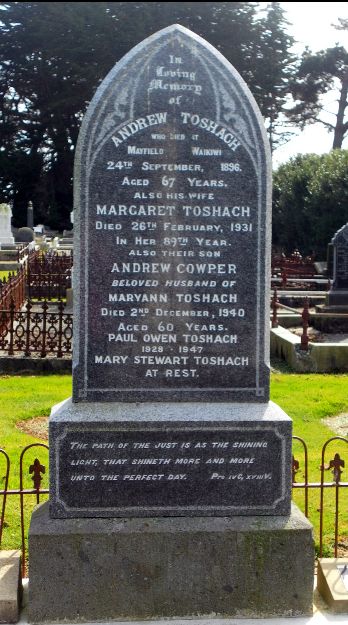
Andrew TOSHACH [16917]
- Born: 25 Mar 1829, Dron, Perth & Kinross, Scotland
- Marriage: Margaret McNAUGHTON [16928] in 1868 in New Zealand
- Died: 24 Sep 1896, Mayfield, Waikiwi, Invercargill, New Zealand at age 67
- Buried: Wallacetown New Cemetery, Southland, NZ

 General Notes: General Notes:
New Zealand Yesteryears
Andrew Toshack is a passenger to Auckland by the ship "Caduceus," in 1858 - London (13 Feb 1859) to Auckland (19 May 1859) Under Captain Cass (95 days out).
NZ Internal Affairs BDM
1896/3120 Toshach Andrew 67Y (recorded death date 24 Sep 1896)
Wallacetown New Cemetery: Plot 17.00 Block1.
Dunedin Probate Indexes - Archives NZ
Name: TOSHACH Andrew
Place: Waikiwi
Court: Invercargill
Agency: DAFG
Series: 9066
Accession: D328
Box: 8
Record Number: 657
Filing Date: 2 Oct 1896
Occupation: Farmer
Type: Intestate (Letters of Administration)
Research Notes:
The Cyclopedia of New Zealand [Otago & Southland Provincial Districts]
Old Colonists
Mr. Andrew Toshach <name-430020.html> was a member of the Provincial Council of Southland for some time, and afterwards served on the County Council. He was also a member of the Southland Land Board for about fifteen years. Mr. Toshach was born in Perthshire, Scotland, in 1829, and came to Auckland by the ship "Caduceus," in 1858. He became a settler in Southland in 1860, and acquired 200 acres at West Plains, where he resided until his death in 1896. Mr. Toshach was married, in 1873, to the daughter of the late Mr. I. McNaughton, and had one son and one daughter.
Southland Times, Issue 2051, 13 January 1875
SCHOOL COMMITTEE ELECTION AT WAIKIWI.
The annual election of a committee for the Waikiwi school took place in the school-house on Monday evening. The inhabitants having assembled to the number of about fifty, Mr Perkins, chairman of the retiring committee, rose to give an account v of the Committee's doings during the past year. In the course of his remarks, and while referring to the matter of Mr Macdonald's resignation, Mr Perkins stated tffat representations having been made to the Committee concerning the manner in which Mr Macdonald had treated Mr Grant's boy (who afterwards died) the matter was investigated by them, and they passed a resolution directing their clerk to inform Mr Macdonald of their opinion of his conduct, and to advise him to send in his resignation, otherwise " efforts would be made to get him put out of the school." Previous to this it was made known that Mr Macdonald very much neglected the school, and that it was no uncommon circumstance for him to go away for two or three days together without asking leave from the Committee. Mr Toshach - This mode of proceeding with the business of the meeting is not in accordance with the terms of the Ordinance. Mr Perkins - I am chairman of this meeting, and if you choose to interrupt me I'll, adjourn it. Mr Toshach - Here is the authorised form of procedure printed by Government ; I will read it. (Hear, hear.) Mr Perkins - I will not allow any chairman but myself - A voice - There's no chairman. Mr Toshach - I will read this clause in the Act. Mr Perkins - I have nothing to do with the Act - I am here in accordance with the Act!, Mr Toshach - We are not here to be dictated to. Tremendous confusion, and shouts of "You're not going to keep us here all night !" and " Shut up ! " Mr Giller would like to throw oil on the troubled waters. Mr Perkins's remarks were exceedingly pertinent - (hear, hear and Mr Toshach would be heard after Mr Perkins had given the explanation, which, as chairman of the out-going Committee, he was entitled to give. Confused cries of " The meeting hasn't commenced yet ! " " Perkins isn't chairman of this meeting ! " " No, no," and " We don't recognise you as chairman ! " Mr Grant (one of the late Committee.) There is no necessity for any disturbance. Keep your tempers , gentlemen ; this conduct is a disgrace to the settlers of Waikiwi. Mr Perkins said that he was there to give a full account of the proceedings of the Committee during the last year, and he would do so if he should have to stay till midnight. Mr Toshach - You're not proceeding according to law ! Mr Perkins - l have my own judgment of that. Mr Forsyth, junior - You're not according to order. I hold in my hand a Provincial Government Gazette Mr Perkins - l'll adjourn this meeting. Mr Forsyth - And we'll elect a new Committee in your absence. The first business is to appoint a chairman, Mr Perkins - I'll hold out till midnight. Mr M'lvor - We will hear whatever you have to say, but you must accord to others the same privilege. Mr Perkins - When I have done. Surely you're not afraid of what I have to say ! A voice - We're not afraid, but we don't care for it. After great confusion and hubbub, Mr Forsyth resumed his seat, and Mr Perkins proceeded. He said that on one occasion he (Mr Perkins) met a gentleman, a friend of Mr Macdonald's, on the road, and he complained bitterly of Mr Macdonald's conduct as a teacher, and he (the speaker) told the gentleman that no notice could be taken of verbal complaints, but if he put his grievance into writing, the Committee would then be in a position to deal with it. As a person wishing to befriend Mr Macdonald, he told him of the complaints which were being made, and Mr Macdonald said, " It's some beggarly Scotchman that's doing that !" The matter came before the Committee, but they took no action, not wishing to be unlenient. Afterwards Mr Macdonald was known to absent himself from the school without asking permission, and when taxed with this delinquency by the Committee, he said, "You're a self-elected committee, and I'll do as I like !" And the Committee were obliged to be content with that. Mr Macdonald - Gentlemen, you're listening to a tissue of lies ; be patient. Mr Perkins continued - He went into the school one morning to look at the roll, which, on finding it, he saw had not been made up for some time. (Mr Macdonald - For how long ?) He affixed a note to the teacher, stating that the roll must be made up every day -that it could not be relied upon if only made up periodically. Some days after that occasion the teacher was in town for a day or two on some land business. How the school got on in the meantime he (Mr Perkins) could not presume to know. The Committee were aware of this action on the part of the teacher, and as chairman, he (the speaker) wrote to the Secretary of the Education Board for advice ; and the Secretary wrote back stating that if the Committee had any charge against the teacher they might investigate it, and take action accordingly. Just to show that the Committee had no desire to deal unfairly with Mr Macdonald, he would state that at a meeting which was held subsequently to this it was resolved - " That the Board be advised that this Committee, after careful consideration of the circumstances, bas come to the conclusion to try Mr Macdonald a little longer." With regard to the case connected with Mr Grant's son, out of which so much capital had been made, he would just refer to it again. Mr Macdonald was called in to the meeting of Committee, and asked whether he would prefer the Committee to make their representation of the circumstances to the Board, or resign. He asked time to consult his wife, and after he had done so he re-entered the meet-ing-room, said we would resign, and on being asked to put it in writing, he sat down there and then and wrote out his resignation. He was perfectly free to do as he liked, and he came to the conclusion that it was best for him to resign. After that, Mr Macdonald's friends seemed to think that he was hardly dealt with, and they got up a memorial requesting him to withdraw his resignation. This document was signed by fifty-nine persons styling themselves parents and guardians of children attending the Waikiwi school, stating that they were satisfied with the treatment their children received from Mr Macdonald, and regretting that he had been induced to resign ; and that memorial was sent to the Education Board. He did not object to those fifty-nine persons informing the Board that they wished Mr Macdonald to withdraw his resignation, but he had a decided objection to all those people calling themselves parents and guardians, particularly since he had found, upon an analysis of the signatures, that twenty-nine" of those gentlemen were single men ! One of those bachelor " parents and guardians" was a young man - he would name him by and bye - who seemed to pride himself on his intellectual ability and the education he had received, and no doubt he looked down upon the Committee with an amount of complaisant condescension which was beautiful to behold ; but he apparently did not understand the meaning of language, and had evidently less learning than boldness. He meant Mr Joseph Forsyth. (Groans, shouts, and general uproar.) Mr Preston - That's slander, and has nothing to do with the business - it's foreign to the subject. I propose that all who are disgusted with the proceedings leave the room. There was great uproar for a short time, but Mr Preston's suggestion was not acted upon. Mr Perkins said he had not come seeking re-election, but he was determined to have his say ; after that they might elect a chairman to their own taste, and conduct the meeting as they liked. Mr Perkins then referred to the rumor that the Committee had tried to get Mr Macdonald's certificate cancelled, and showed that the Committee had never tried any such thing, and that the rumor had obtained currency through the repetition of a parenthetical remark made by the Secretary to the Education Board, and not intended to result in the cancellation of Mr Macdonald's certificate. With regard to the correspondence which had appeared in the newspapers anent the Waikiwi school question, all he would say was that be had written to the Editor "of the Times, but he would scorn to publicly notice the small iry of letter-writers who meddled with the subject. Referring to the conduct of the settlers in the matter, he would say that it used to be the boast of Scotchmen to protect the innocent; but the Scotchmen about "Waikiwi must be a degenerate race, for they had reversed the custom of their country, and stood forth as the defenders of one who tyrannised over the young and innocent, and against the Committee, who opposed such a man. (Hear, hear.) Mr Perkins then sat down, and after proposing several others, who refused to act, the meeting appointed Mr Toshach ' to act as chairman. Mr Toshach read the Ordinance describing the procedure that should be ' followed on such occasions, and maintained that Mr Perkins had acted irregularly. After some desultory discussion, Mr Perkins, in response to a call from the meeting, stated that the school fees due up to the 31st December, 1874, amounted to £105 7s 10d, which had been properly appropriated by Mr Macdonald in payment of his salary, but with regard to the question of attendance, the circumstances in which the Committee had been placed rendered it impossible for them to give any reliable information. Mr Macdonald (the late teacher) then asked Mr Perkins several questions, and addressed the meeting at some length, denying the accusations brought against him by Mr Perkins and the Committee. He maintained, in substance, that the integrity and propriety of his conduct as a teacher would not have been impugned by any but men who were personally opposed to him. Mr Forsyth, junior, followed in a similar strain, and concluding by moving - That Messrs Lind, Buxton, Fowler, Paterson, Hanna, Forsyth, senior, Lenuie, Macdonald, and ; Toshach be elected the committee of the Waikiwi School District for the ensuing year. The motion having been seconded, Mr Giller proposed as an amendment, and Mr Hormann seconded - That the old Committee be re-elected. - Fourteen voted for the amendment, and the motion, on being put, was carried - amidst the tumultuous excitement of a large majority. The meeting then adjourned.
Southland Times, Issue 2567, 16 October 1876
MAKAREWA ROAD BOARD.
This Board held its monthly meeting on Saturday. Present - the chairman, Mr D. McArthur, and Messrs J. Thomson, Toshach, Mclvor, Keith, Grey, Hamilton, G. Thomson, and Baldy. In reply to communications from the Board, the Provincial authorities in Dunedin wrote that there was no objection to the Board cleaning the ditches on the North road at its own expense, but stated that there were not in the Provincial Treasury any funds which could be devoted to such a purpose. The Board resolved to clean the ditches at its own expense. Mr L. Hume applied to have a roadline passing through section 19, block 17, Invercargill Hundred, diverted. A number of settlers objected to this by letter. Held over for the Engineer's opinion. Permission was granted to Mr Mclvor to erect a swing gate on a road between the Lindhurst and Makarewa districts - the Lindhurst Board concurring. A letter .from Mr Buxton regarding certain work, for which he claimed £25, was held over for the Engineer's report. The matter of Mr Gorman's request for an exchange of road in the Wallacetown subdivision was referred to a sub-com-mittee with power to dispose of the same. Mr Toshach's notice of motion - That the resolution of July 10, 1875, appointing committees of subdivisions and conferring certain powers on such committees, be revoked, was considered. He said that he did not disapprove of the committees themselves, but the object of his motion was to confine the acceptance of tenders to the Board itself. This was necessary to prevent entanglement of accounts in view of the pending constitutional changes. Mr G. Thomson seconded the motion. Mr Keith moved and Mr J. Thomson seconded as an amendment - That the committees remain as they are at present, and have the same power to accept contracts. Mr Thomsom said that if it was attempted to deprive the Winton subdivision of its present powers, it would have to consider the desirableness of having itself made au independent Road
Board. With regard to* the Winton subdivision overdrawing, at tbe Bank, that had been. necessary in order to make the roads, and the overdraft would be paid off in due time without any assistance from the other subdivisions, or without-in any way encumbering them. In fact sooner than have any bother about the matter he would be personally responsible.. The amendment was negatived, and the motion was affirmed. Mr J. Thomson remarked that they would come to the meeting no more - they would have a district of their own. A rate of one shilling in the £ for the year ending 30th June, 1877, was ordered to be struck. Mr Dawson tendered his resignation as Engineer to the Board and gave a satisfactory explanation why he had not visited certain works previously referred to by the Board. Mr Dawson's resignation was accepted. Mr D. W. McArthur was appointed to act as Engineer to the Board on the same terms as Mr Dawson's per cent, on the works executed under his supervision. The members of Winton subdivision notified that they were willing to reduce the overdraft to £600 during this year, to £400 next year, and so on till all paid off. Mr Toshach deprecated in strong terms the Winton subdivision's having such an overdraft, for which they were paying 9 per cent., a most illegal proceeding. He opposed the whole arrangement, and unless the Board agreed with him, he would have the matter brought before the ratepayers. The proposal was accepted as satisfactory, Messrs Toshach, Grey, and G. Thomson dissenting, and Mr Baldy not voting. The Board then adjourned.
Southland Times, Issue 2682, 12 February 1877
MAKAREWA ROAD BOARD.
This Board held a meeting on Saturday, chiefly for the purpose of considering a motion passed at the last meeting of the County Council, to the effect that the County Council not being in a position to undertake certain works on main roads reported by the Engineer as being urgently necessary, the Road Boards should be invited to execute the works, the county to pay tor them on the receipt of certificates of completion being handed in by tbe engineers employed by the boards and the county. There were present - Mr D. McArtbur (chairman), and Messrs Baldy, Grey, Keith, Mclvor, G. Thomson, J. Thomson, and Toshach.
Mr Mclvor, as one of the committee appointed to visit and inspect Outara road, advised that the Board should give the present line to Mr L. Ackers in exchange for a line farther removed from the river, which occasionally overflowed the present line, rendering it impassable. The Board resolved that steps be taken to close up a portionp of the road through the sections of Mr Atkers, and to open up a new road along the terrace
Mr Baxter Pyke asked if he was not entitled to have a separate assessment on Sections which were held under separate leases. He might wish to appeal against the valuation on one of the sections, but being valued together, how could he do so. Mr Pyke was advised if he felt in any way aggrieved by the valuation to appeal to the Assessment Court.
A petition was received from settlers in the Otatara district urging the Board not to grant the deviation asked for by an absentee of the road through sections 19 and 20, block 17, Invercargill Hundred. Mr Angus, on behalf of Mr J.H. Smith, spoke strongly against the deviation asked for by Mr L. Hume, who was referred to in the petition as ai absentee - a non resident owner of land in the locality. Mr Angus said that Mr Hume was the only landowner in the neighborhood who wished to have the road altered.
The chairman said that personally he had no interest in the matter, but he knew that the road it present used was nofc the track originally surveyed. Mr Wade said that the present road was allowed to the settlers through the courtesy of Mr Hume, and there was nothing to hinder him fencing it across. The fact was that the settlers now wished to claim as a right that which they first obtained from Mr Hume as a tavor. To allow the road to remain as it now is would interfere with Mr Hume using the most suitable site for a house on the property, and he simply wished the Board to revert to the road laid down oq the map.
Mr Toshach moved that no steps be taken to alter the track at present in use, as the majority of those settlers are satisfied with it. This was seconded by Mr G. Thomson.
Mr Mclvor was as eager to do justice to one man as to twenty, and moved as an amendment that the matter be adjourned till Mr Smith's return. The Board unanimously resolved to adopt this suggestion. The Winton School Committee wrote asking the Board to gravel the approach to the school from the crown of the road.
Referred to the Winton subdivision
Mr Crosbie wrote asking that two independent members should visit the road passing !m homestead, as it was very necessary that something should be done. Mr J. Thomson read a long letter
members of the Winton subdivision, urging them to expend more money on the road in question, and expressing a belief that the memoers were influenced by personal feeling towards him. The committee had written to Mr Crosbie declining to act upon his recommendation, and stating that the latter part of his letter was nothing but an intentional violation of truth.
The Board considered that the committee had dealt with the matter.
Mr Hodges Swain wrote complaining that thistles on the road near his land were spreading all over the place, and becoming a nuisance. The Board held that it could not entertain the complaint.
Several accounts were passed
The Board then proceeded to consider the communication from the County Council, on account of which the meeting had been specially called.
The chairman read the descriptions uud estimates of the works which the Council wished the Board to undertake.
A conversation ensued on the proposal. Mr Toshach hoped the Board would do nothing according to the County Engineer's report, and Mr Baldy said the Council would not recoup for the works otherwise. The expenditure involved by adopting the proposal amounted, it waa stated, to L 2346 103, Mr Mclvor recommended that the Board should accede to the Council's proposal, but thought it would be well to allow the various subdivisions to manage the works within their respective boundaries. It was not necessary to undertake all the works proposed, and therefore the Board need not undertake the work from McKellar's gate, along towards the beach on the way to Riverton, for the work was foolish, and would if executed become as striking a monument of folly as the Mokomoko jetty. Mr Toshach thought the proposal of the County Council was not creditable, and that they should have tackled the work manfully themselves. Mr Baldy said the Council was not in a position to undertake the works itself, but being desirous of attending to the public interests, the Council appealed to the Road Boards. Besides, the Board need not spend more than LIOO(£100) of the money unless it liked, and the Board, under any circumstance, would not lose money. Mr Mclvor moved that the Board accept the responsibility which the County Council asked it to do. This was seconded by Mr Grey. The Board being under the impression that certain of the works proposed were estimated at too high a figure, Mr Mclvor agreed to add to his motion that the chairman and Mr tfaldy should wait upon the Council to express this view. Mr Toshach moved as an amendment that the further consideration of the proposal should be postponed till next meeting of the Board. This was not seconded, and Mr Toshach proceeded to move a further amendment, but his introductory remarks were ruled by the chairman to be utterly irrelevant, and Mr Toshach left the room, saying that he had not received fair play. His amendment was - That the chairman of the County Council be informed that this Board declines to take charge of the main roads, as it is the duty of the County Council to take charge of these roads. Mr McIvor's point was then carried, and it was resolved that Messrs Mclvor and J. Thomson should wait on the chairman of the County Council in conjunction with the chairman and Mr Baldy, and thereafter put in hand the most necessary of the works. Mr W. J. Moffett asked that something might be done to divert the water which lodged at his property in the Waikiwi. It was resolved that a drain should be fit for the purpose.
Mr J. Thomson, seeing that the assessments for road-making are likely to press heavily on the present generation, begged to move - That this Board exercises its privilege of borrowing to the extent of the powers conferred by the Act. The motion lapsed.
It was resolved on the motion of Mr Baldy, that the Chairman see the BankManager with the view of getting the Board's overdraft, if any, at the same rate of interest as the County Council.
The Board then adjourned.
Southland Times, Issue 2994, 31 January 1878
Untitled
At the statutory meeting held at the school house, VVaikiwi, on Monday evening, the following gentlemen were elected members of committee or the coming year, namely, Messrs Toshach, Rankin Mclvor, Ward, Horman, Brass, and Perkins. The thanks of the meeting were rendered to Mr Hawson, the teacher, for the past year's services.
Southland Times, Issue 3295, 11 January
Office of the Southland
Board of Education,
Invercargill.
I Do hereby publicly notify that the names of the following gentlemen have been transmitted to the Board by the Committees of the several School Districts, as the names of persons qualified to fill the vacancy in the Board caused by the death of the Hon. Sir John Richardson, that is to say, Thomas Denniston of Invercargill, Samuel Hodgkinson of Mt. Fairfax, Andrew Kinross of Myross Bush, John Morrison of Dipton, Thomas Perkins of Invercargill, Andrew Toshach of Waikiwi.
And I do hereby appoint Friday, the thirty-first day of January instant, as the day on which each of the said Committee shall send in to the Board the name of one of the persons above mentioned to fill the said vacancy. And I do hereby appoint Friday, the seventh day of February next, as the day on which the Board will hold the election to fill the said vacancy.
Dated this sixth day of January, 1879.
THOS. M. MACDONALD
Chairman
Southland Times, Issue 3838, 8 October 1880
SOUND THE TRUMPET.
TO THE EDITOR. SiR, - It seems highly probable that during the next decade an unusually large number of British farmers will make up their minds to emigrate. Under these circumstances those of us who have been here for a long time would do well to forward plenty of newspapers to their acquaintances in the home country. Farmers who have been long in business in the old country are generaly pretty shrewd; as a rule the - dislike emigration books, knowing well that books about the colonies soon get out of date; also that they generally exhibit the bright side of the picture and keep the dark side out of view, but give a farmer who is contemplating emigration a newspaper from the colony he has been thinking about, and he will be sure to go over it carefully, and extract from it, if it is a well got up paper, the very kind of information he wants. Passing by the political jabbering of the "outs and ins" he will go straight to the " Prices Current," and from that to the Auctioneers' reports, anil tho shipping reports, and he will be sure to pay attention to the style and character of the advertisements. It is sometimes said that the newspapers will tell our friends things which we do not wish to be proclaimed upon the housetops; that maybe, but it is best that they should knew the real state of the case, and then, if they do come here, they will have no excuse for grumbling. Besides, men who know the world quickly separate the facts from the fancies. They go by facts ; and the stuff which schemers and idlers insert in the papers from time to time has little or no effect upon them. A few weeks ago I received a letter from a fanner who is at present settled on the Continent of Europe, and his request was, "send me a newspaper" - and I did it. The postage was only 2d; to the United Kingdom the postage is only Id. Few of us seem to give sufficient weight to the fact that merely by fixing a penny stamp on a newspaper it can be made to fly across the world.
It seems to be the general opinion that a crisis in British agriculture is rapidly approaching. The number of live oxen from America which are landed every week at the port of Glasgow is altogether astonishing, considering how recently the trade has sprung up. In May, 1879, the number landed was only 435 ; in May this year, 1802 have been landed. If this rate of increase continue, the price of meat in the home country must come down, and then the British farmers will have a hard struggle to pay their rents ; even now many of the landlords find themselves compelled to give back 10 per cent., to keep their tenants from throwing up their farms. Ever since the repeal of the corn laws the high price of butcher's meat has been one of the principal supports of British agriculture. In addition to the 1802 live oxen landed last May at Glasgow, 2317 carcases of oxen were also received, so that by this time we shall not be shooting on the wing if we say that one thousand American oxen are being landed every week at Glasgow. As regards the trade in tinned and otherwise preserved meats, the increase is simply enormous. The following quantities were landed at Glasgow in May last, all from America:- 3606 boxes tinned beef, 3554 packages of salt beef, 1135 packages of hams, 772 packages of pork, 5085 packages of bacon, 11,500 tubs of butter, 14,600 boxes of cheese, and 5580 tierces of tallow and lard. The prospects of enlarged supplies are extending every day, in fact the tremendous lines of railway which the American people have built are just beginning to tell, and it seems to be admitted on all hands that quite a revolution in British agriculture is looming in the distance. - I am, &c., Andw. Toshach. Waikiwi, 6th Oct., 1880.
Southland Times, Issue 4653, 9 June 1883
Untitled
A Neglected POLICY.-- Reserves of land are plentiful throughout the colony for Public Works purposes, as a rule; that stone, gravel, or similar materials may be procured, Reservations of bush land for such purposes are, however, rare, if not unknown. This matter was brought before the Waste Lands Board, at its last meeting, by Mr Toshach, who pointed out that the locality under discussion (Makarewa Bush) was surrounded by road districts swarming with small timber bridges and culverts which are continually needing repair, yet the public bodies had not a piece of bush land from which to cut a pile or beam or to send a contractor into for materials for a bridge - the consequence being that such works cost more than they would otherwise do. Mr Toshach suggested holding over the application (for 500 acres of timber) until the County Council should have an opportunity of discussing tbe question of putting in a claim for a timber reserve. Mr Lumsden thought that it was rather late in the day to begin to reserve bush for County Councils : besides these bodies should look out for themselves. Other members expressed themselves as impressed with the importance of Mr Toshach's suggestion, but in the absence of pressure from without, the matter dropped. Perhaps our local public bodies may yet discuss the subject.
Southland Times, Issue 11567, 27 October 1890
Bible-Reading in Schools
TO THE EDITOR. Sir, - lt was with a feeling of thankfulness that I read your leader of 18th inst. on the above subject. It is by far the most important question that can engage our attention at the present time. The Roman Catholics have all along held - and rightly too - that there ought to be religious instruction in the schools, but the attitude of many Protestants on this question is blameworthy and short-sighted in the extreme. I have heard the question put to a candidate - " Which Bible do you propose to bring in - the Protestant or the Roman Catholic version ?" Now this is a Protestant country. It is a fundamental part of the British Constitution that the Sovereign must be a Protestant. Queen Anne died in 1714 ; all her children had pre-deceased her, and consequently there was a break in the succession. George Louis of Hanover was called to the throne, being a descendant of the Stuarts, and being the nearest Protestant heir. Queen Victoria reigns because she is a Protestant,- and under these circumstances if there is to be a Bible in the national schools it must be the Protestant Bible. The present system of education is certainly unjust to those who have conscientious objections to a purely secular system ; and as the Roman Catholics have made great sacrifices for the sake "of giving effect to their religious opinions I consider that they are entitled to every consideration. At the risk of giving offence to some I would say that seeing that they have built schools out of their own resources they ought to get their fair share of the capitation grant in aid of these schools. That would remove one great difficulty ; and then the Protestant denominations (sinking small differences) could arrange for a system of Bible-reading and religious instruction in the public schools. I would beg those who favour the present infidel system of education to reflect that " like draws to like." At present we have few infidel teachers, but let this system continue for ten years longer (which God forbid), and we will have many of them. What then? It may be said that they will have to keep their infidelity to themselves : they cannot do that, if the light be in a man it will shine ; if darkness reign it will shade. It is easy for a man, by look and gesture, without speaking a word, to show his contempt for religion. Bearing in mind the authoritative position of a teacher, and how ape the children are to imitate him in his bad ways (if he has any) the influence of an infidel teacher or those who are under him must be fearfully, perhaps irretrievably, pernicious. Sir R Stout once said at a public meeting that if we brought the Bible into the schools we would need to see that the teachers were sound in the faith. The idea seemed to afford him some amusement, but it would be a blessing indeed to the country if all the teachers were sound in the faith. This is not a matter which we can neglect without great guilt and danger. It seems to me that we are acting like a lot of eyeless reptiles, creeping along the ever-narrowing ledge of a precipice. To separate the religious and moral from the intellectual in the training of the young is to perpetrate a fearful outrage on the constitution of the human mind ; and if there is trust in Nature or truth in religion, the present infidel system of education, if much longer continued, will assuredly bring a judgment on the land ; the Protestant churches will get broken up, in fact the disintegrating process has already commenced. - I am, &c, Andrew Toshach.
Andrew married Margaret McNAUGHTON [16928] [MRIN: 6231], daughter of John McNAUGHTON [17073] and Mary Jane BRODIE [17074], in 1868 in New Zealand. (Margaret McNAUGHTON [16928] was born circa 1843, died on 26 Feb 1931 in Mayfield, Waikiwi, New Zealand and was buried in Wallacetown New Cemetery, Southland, NZ.)
Marriage Notes:
NZ Internal Affairs (online) Marriage
1868/9527 Margaret McNaughton Andrew Tosbach [sic]
NZ Kiwi Index
NZ Bride and Groom Records:
Name: TOSHACK Andrew
Date: 1868
Sex: M
Folio: 2298
Spouse: McNAUGHTON
|